Wastewater
AI Aeration Control for Sewage Treatment Plants: How It Works
·Pathmanathan Muniandy
Key Takeaways
- Aeration blowers are typically the largest single energy cost at a sewage treatment plant — the savings come from matching blower speed to real-time oxygen demand instead of running at a fixed rate.
- AI-driven control continuously adjusts based on live dissolved-oxygen, flow, and level sensor data, rather than periodic manual checks.
- The same sensor network that feeds aeration control also supports predictive maintenance and automated compliance reporting.
Why aeration exists, and why it's expensive
Most sewage treatment plants use an activated sludge process: bacteria break down organic matter in the wastewater, and those bacteria need oxygen to do it. Blowers pump air into the aeration tanks to supply that oxygen. It's a straightforward mechanism — but blowers are large motors running continuously, and in most plants, aeration accounts for the largest share of total electricity consumption.
The traditional approach: run it at a fixed rate
Without real-time feedback, the simplest way to operate a blower is at a fixed speed calibrated for worst-case load — peak organic loading, peak flow. The problem is that actual demand varies constantly through the day and across seasons, driven by inflow volume and load composition. A fixed-speed blower run for worst-case conditions is over-aerating most of the time, which is wasted energy with no treatment benefit — dissolved oxygen beyond what the biological process needs doesn't improve effluent quality, it just burns electricity.
How AI-driven control closes the loop
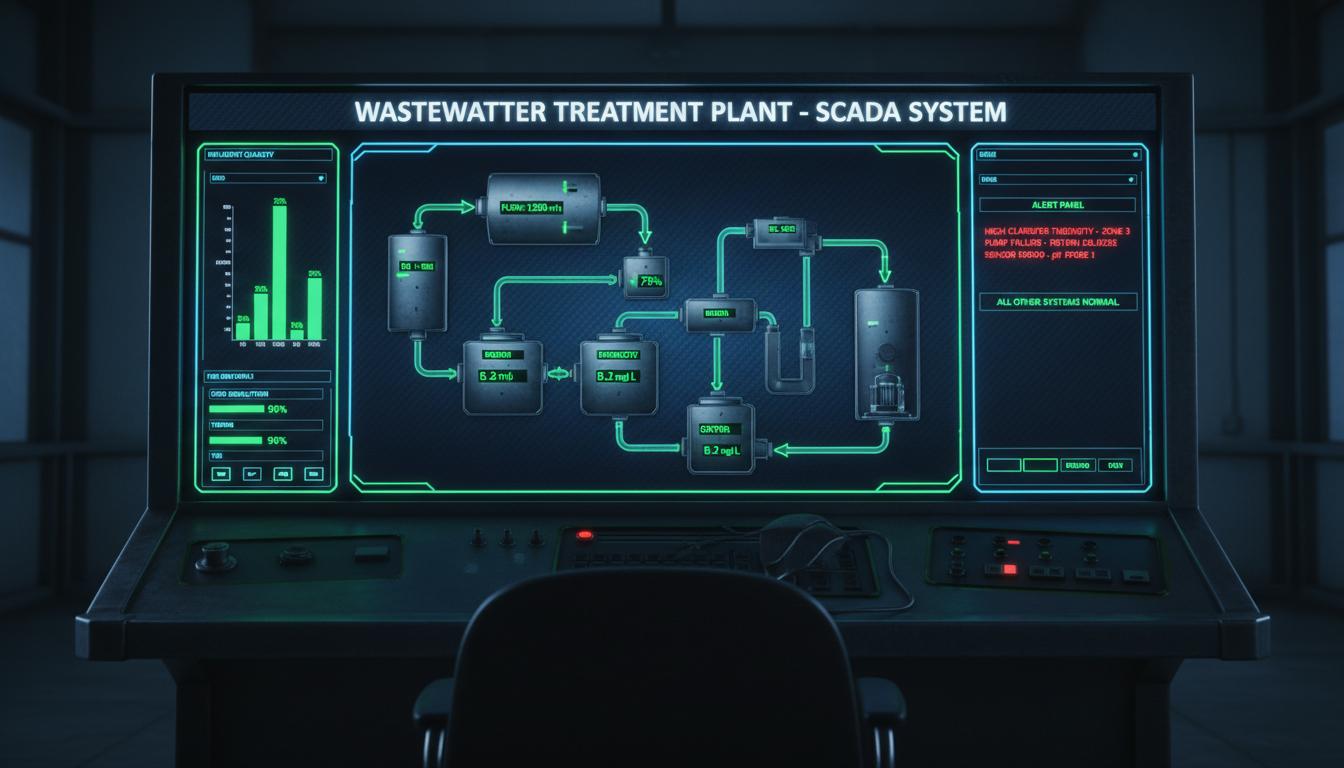
The fix is a feedback loop: real-time sensors continuously measure dissolved oxygen (DO), flow, level, and turbidity in the aeration tanks. An AI-driven controller reads that data and adjusts blower speed to hold DO at the level the biological process actually needs at that moment — no more, no less. When inflow and load are low, blower speed drops with it. When load spikes, aeration ramps up to match. The plant is no longer aerating for a fixed worst case; it's aerating for the current, actual condition.
- Real-time sensor network: continuous flow, level, pH, turbidity, and dissolved-oxygen monitoring across the treatment train.
- Adaptive blower control: AI-driven adjustment of aeration and pumping to match measured demand, not a fixed schedule.
- Typical result: energy savings in aeration on the order of 15–30%, based on how far actual demand runs below the old fixed-rate baseline — the exact figure depends on the plant's existing setup and load profile.
It's the same sensor network doing more than one job
The instrumentation that makes aeration control possible — continuous flow, level, and quality sensors — doesn't only serve energy optimisation. The same data stream supports predictive maintenance (vibration and temperature trending on pumps and blowers, flagging likely failures before they cause unplanned downtime) and automated compliance reporting (continuous effluent quality monitoring instead of periodic manual sampling). One sensor network, three operational benefits, which is generally what makes the business case for retrofitting AI-driven control worthwhile beyond the energy savings alone.
Explore how Cre8 IOT builds scalable, sustainable technology solutions for your industry. See our solutions →
Related